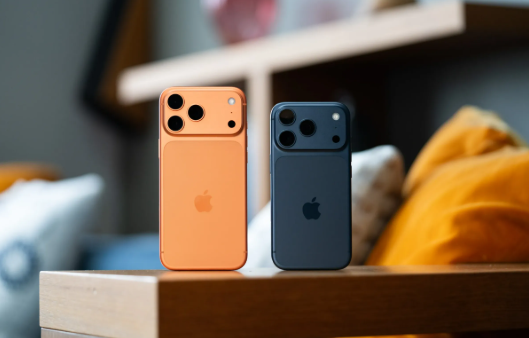
The iPhone 17 Pro Max (released Sept 2025) features a 6.9-inch 1-120Hz ProMotion display, an A19 Pro chip with 12GB RAM, and a 48MP triple-camera system with 8x optical zoom. It includes a vapor chamber for thermal management, a 48MP front "Center Stage" camera, and up to 39 hours of video playback.

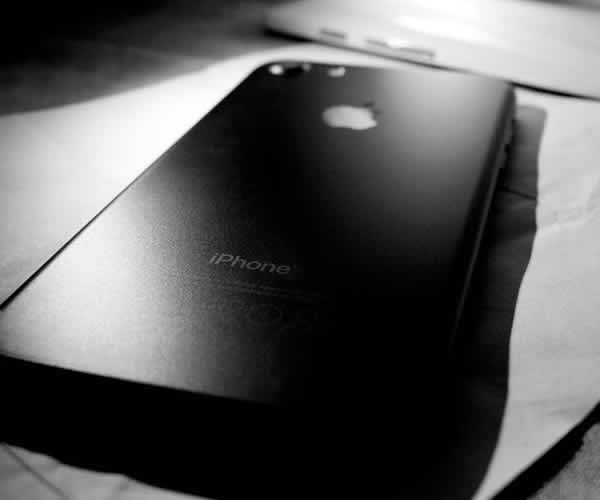
For the 2025-2026 cycle, Apple gave the Pro iPhones a new design and a change of materials. The frame of the iPhone 17 Pro and 17 Pro Max are made from a single piece of aluminum, and this shows in how the device feels in the hand. On the iPhone 16 Pro Max, the titanium frame feels noticeably smoother than the glass back of the device; in contrast, the sides and back of the iPhone 17 Pro Max feel remarkably similar, to the point that I really had to carefully run my fingers across the back of the device to feel where the aluminum unibody ended and the glass back began. This new design is a subtle tactile difference that, to me, makes the iPhone 17 Pro Max feel more cohesive.
While the aluminum unibody is a subtle design change that many may not notice, the 'plateau' is anything but. Introduced on the iPhone 17 Pro/Max and also the iPhone Air, the plateau is a raised rectangular area on the top-back of the phone that houses the cameras, processor, and other components. Whereas on the iPhone 15 and 16 Pro/Max the cameras were housed in a small square-shaped area immediately surrounding the cameras, on the 17 Pro/Max the plateau extends across nearly the entire width and top-third of the device. While this isn't a huge change in terms of overall device thickness, the plateau is left uncovered by at least some Apple-branded cases (I cannot comment firsthand on anything else); leaving a rather large portion of the back of the device unprotected. While I suspect that this is because some camera components are located on the opposite side of the plateau, this is nevertheless disappointing for those who, like me, keep their devices in a case. And of course, there will be no setting this or any other modern iPhone flat on a table, period.. .
One of my biggest pain points about the iPhone 16 Pro Max was the speakers. At low volumes, the iPhone 16 Pro Max's speakers sounded flat; with okay mids and both little base and little high end; whereas at high volumes, the speakers had a lot of base and high end, but comparatively less in the mid range. Apple has, for the most part, addressed this issue with the iPhone 17 Pro Max. The bottom speaker (which is now located on the bottom-left of the device) is much more consistent across all volume ranges, particularly at lower.

volume levels. Side-by-side, there is a noticeable difference between the iPhone 16 Pro Max and the iPhone 17 Pro Max; with the iPhone 17 Pro Max sounding 'clearer' and 'fuller'. On reflection I still think that the speaker on the iPhone 16e has more bass than the iPhone 17 Pro Max (and this is saying something, because the iPhone 16e costs half as much as the iPhone 17 Pro Max at the time of writing), but I unfortunately only had the iPhone 16e on loan and thus cannot now compare it to the 17 Pro Max firsthand. Regardless of whether or not the iPhone 16e's speakers are really better than those on the iPhone 17 Pro Max. .
Performance on the iPhone 17 Pro Max has been better by leaps and bounds, and this is coming from someone who upgrades every year and thus has seen my fair share of new devices running the latest OS. As a blind user, I measure performance by how quickly VoiceOver responds to touch inputs and how quickly I can swipe through elements on the screen. And the iPhone 17 Pro Max excels in both..
VoiceOver is incredibly responsive to touch gestures, even when using voices which are not the lowest of latency. When doing the initial device setup, I noticed right away how much more responsive the default 'Samantha Compact' voice was; with VoiceOver responding near-instantaneously to touch inputs and no lag when swiping around the screen. While your mileage may vary (Siri Voice 4, for example, still has a delay when navigating), my past experience using the 'Samantha Compact' voice has been that it is middle-of-the-road in terms of responsiveness; suggesting that something about the new phones (either the A19-series processor or the increase to 12GB of ram on all models except the base iPhone 17) is helping with VoiceOver performance...
If I have one complaint about the iPhone 17 Pro Max, it is that so far, I have not noticed a meaningful improvement in battery life over the previous-generation phone; when everything I have read suggests that I should be. According to Apple, the iPhone 17 Pro Max offers up to 39 hours of video playback and 35 hours of streamed video playback on a charge. Armed with these expectations, I had very high hopes..
On most days, I usually finished the day at somewhere between 55 and 60% charge; with 58% seeming to be the number I ended at most often. The lowest I recall getting my iPhone 17 Pro Max to so far is 41%..
While these numbers are very good, they are by no means extraordinary for a Pro Max model. In fact, when I wrote my review of the iPhone 16 Pro Max at this time last year, I noted that the lowest I had gotten that phone, with about the same amount of use and similar usage pattern, was 53% charge. If we exclude the day I got the iPhone 17 Pro Max's battery down to 41% (a day which included playing a Facebook live video of a state government news conference for around an hour, which undoubtedly drained the battery quite a bit), I still have ended multiple days below last year's 53% threshold. And this is with display brightness at 0%, iOS 26's Adaptive Power settings enabled, and no changes made to Background App Refresh settings..
To be sure, battery life on the iPhone 17 Pro Max is very good. And when compared to an iPhone 16 Pro Max running iOS 26, there is a definite improvement. (Put another way: After installing iOS 26 on my iPhone 16 Pro Max, I noticed a decrease in overall battery life.) But if we compare out-of-box battery life between an iPhone 17 Pro Max running iOS 26 and last year's iPhone 16 Pro Max running iOS 18 (that is, two devices running the original OS versions they were shipped with), real-world battery life is about the same year-over-year with no meaningful gains. And that is a bit of a disappointment, as Apple's marketing had me expecting something significantly better on a grand scale. Is it good? Yes. Is it good for a Pro Max phone? Yes. Is it the best battery life in an iPhone? Yes. It just isn't an improvement over what I saw last year when my iPhone 16 Pro Max was new.
At some point every year, I inevitably hear the question (either on AppleVis or in person), "What iPhone should I get?" That question is fascinating and could probably be an entire article in and of itself (and maybe one day, it will be). In the meantime, below are some thoughts:.
While I have not yet spent any time with the iPhone 17 or iPhone 17 Pro, my educated guess is that either model, or the aforementioned iPhone 17 Pro Max, will serve you well. Due to the single-speaker design and relatively less battery life of the iPhone Air, I cannot in good conscience recommend it unless you already know that is the phone you want and are okay with the compromises.


About author

You may also like
3 Comments
Leave a Reply

Trend Videos


Popular Posts

Recent Reviews


Scroll to Top
Amanda Martines 5 days ago
If you know you want a Pro iPhone, your choice will largely depend on which size of device you want and how much you are able to pay. The iPhone 17 Pro has a 6.3-inch screen and offers up to 33 hours of video playback and up to 30 hours of streamed video playback;.
ReplyBaltej Singh 5 days ago
screen and offers up to 39 hours of video playback and up to 35 hours of streamed video playback. Besides device/screen size and battery life, everything else is the same between the iPhone 17 Pro and iPhone 17 Pro Max. Both phones are likely to be excellent. As the saying goes, "What kind of ice cream do you want? Chocolate or vanilla? They're both good."
ReplyMarie Johnson 5 days ago
Nextiva is a cloud-based communications platform with voice over internet protocol (VoIP) that bundles business phone numbers, texting, call center operations, call tracking, and audio conferencing. It helps streamline operations while boosting customer engagement and team collaboration. .
Reply